


The Look Your Dog Gives You When They're Bored... (And How to Avoid It)
What the stare really means, the boredom signs that matter, and six fixes ranked by effort.

You know the one. Head on the arm of the couch, eyes tracking you across the room, not blinking. No barking, no pawing, no toy dropped in your lap. Just watching.
Most people read the bored dog stare as plain boredom. It is usually something more specific, and the difference matters, because the wrong response teaches your dog to do it more.
A dog's stare usually means "something is supposed to happen now, and it is not": a broken routine, an unmet need, or a habit that has paid off before. Real boredom comes with other signs, like chewing, pacing and evening restlessness. The fix is a meal from a frozen toy, more sniffing, and getting ahead of the restless window instead of answering the look.
Why does my dog stare at me?
Dogs stare at people far more than other animals do, and they do it because it works. Somewhere in your dog's history, looking at you produced an outcome. Food appeared, a walk happened, you spoke to them, you got up. The behavior was reinforced, and now it is their default way of asking.
The stare is a question, not a complaint: something is supposed to happen now, and it is not happening.
That points you at the useful question: what does your dog think is supposed to happen? Four common answers:
A routine has been broken
- The walk usually happens at four, and it is now half past
- Dogs keep time well
A need is unmet
- Water bowl empty
- Needs a potty break
- Uncomfortable or too warm
They have run out of things to do
- The genuine boredom version
- Usually arrives after a stretch of nothing, not out of nowhere
It has worked before
- The learned version
- Staring got a treat once, so staring is now the strategy
The last one is the most common in homes where the dog is well cared for and still stares constantly.
Is my dog bored, or is it something else?
Boredom is one explanation among several, and the others matter more.
| What you see | More likely explanation |
|---|---|
| Staring, plus following you room to room | Attachment behavior, or a learned habit |
| Staring at a fixed time each day | Routine expectation |
| Staring with restlessness, pacing, circling | Needs a potty break, or discomfort |
| Staring that is new in an older dog | Worth a vet visit: pain, hearing or vision loss, or cognitive change |
| Staring at a wall or at nothing | Not attention-seeking. Speak to a vet |
| Staring, then chewing something they should not | Genuine under-stimulation |
| Staring with a hard, still body and a fixed jaw | Not boredom. Give space and speak to a behaviorist |
- Sudden change in an adult or older dog: a clinical question first, not a toy question.
- Staring into space or at a wall: can indicate cognitive dysfunction or a neurological problem. See your vet.
- No amount of enrichment fixes either of these.
What does real boredom look like in a dog?
If the stare is one item on this list, boredom is a reasonable read. If it is the only item, go back to the table above.
Early signs, easy to miss
- Sighing heavily and repositioning, over and over.
- Following you between rooms with no interest in what you are doing.
- Bringing you a toy, then losing interest in it immediately.
- Sleeping far more than usual during the day, then restless in the evening.
- Nudging, pawing, leaning.
Later signs, harder to miss
- Chewing furniture, baseboards, shoes.
- Barking at nothing in particular, and not stopping when the trigger has gone.
- Digging at carpet or bedding.
- Raiding the trash.
- Pacing a set route.
- Waking you early.
Signs that have gone past boredom
- Repetitive behavior that cannot be interrupted: spinning, tail chasing, flank licking, shadow chasing.
- Destruction focused on doors and windows.
- Distress that only happens when you leave.
That last group needs a vet or a behaviorist. Compulsive behaviors are much easier to prevent than to unpick once they are established.
What does a dog need every day?
Four things, listed in order of how often they get missed. Most owners cover the first and neglect the rest.
- Physical exercise. Usually covered.
- Sniffing. Almost always underrated. A dog's walk is mainly a sensory experience, not a cardio one. Twenty minutes where your dog sets the pace and stops constantly does more for their brain than forty minutes of brisk heel work. If you change one thing about your walk, let them sniff.
- Problem-solving. Working food out of something is genuinely tiring. This is the gap in most homes, and the easiest one to fill.
- Chewing and licking. Both are self-soothing behaviors that lower arousal. A dog with no acceptable outlet for chewing will find an unacceptable one, and it will be something of yours.
The order matters. A dog who has been walked but has done nothing mentally is still under-occupied. Physical tiredness and mental satisfaction are not interchangeable, and for some breeds more exercise makes things worse, not better.
Is fetch a good cure for a bored dog?
For many dogs, fetch is great. For some, repetitive high-intensity ball chasing produces an adrenaline-driven state that is the opposite of settling. Those dogs finish a twenty-minute fetch session more wound up than when they started, and some develop a real fixation, where nothing else holds their interest and taking the ball away causes distress.
This shows up most in herding and working breeds. Our Border Collie enrichment guide covers the over-arousal problem in the breed where it is most pronounced.
The alternative that settles instead of winding up: nose work, food puzzles, licking and chewing. All of them tire a dog out without the adrenaline spike. A dog who has done twenty minutes of scent work lies down afterwards. A dog who has chased a ball for twenty minutes often does not.
How do I keep a bored dog busy?
Six fixes, ranked by effort against result. The first one does most of the work.
1. Feed a meal from a toy instead of a bowl
The highest-return change available, and it costs nothing extra.
You have turned a non-event into the longest structured activity of your dog's day, using food they were going to eat anyway. Because the food comes out of their existing ration, it adds no calories. That matters, since the usual mistake with enrichment is adding treats on top of meals and ending up with a heavier dog.
Start with breakfast. Soak the measured portion the night before, pack it in, and freeze it overnight. A small Freezbone holds up to 45g and a large one up to 90g, which makes portioning simple.

2. Give it at the right time of day
Most dogs have a predictable restless window, commonly between four and seven in the evening. Giving the session then, instead of whenever it is convenient, makes it far more useful.
Walk first, then give the toy. An unexercised dog attacks it. A walked dog settles into it and often falls asleep partway through, which is usually the real goal.
“Layla loves this ! She spends a good 30 minutes with it in the afternoons when she doesn’t get her second walk of the day .”
Lisa D., verified buyer
3. Make the session last
If your dog finishes in five minutes, the fill is the problem, not the toy.
- Freeze overnight, not for an hour. A soft center is a shortcut.
- Use a liquid base. Unsalted broth freezes far harder than peanut butter and lasts much longer.
- Pack it tight. Air pockets are shortcuts. Thirty seconds of pressing adds ten to fifteen minutes.
- Layer it. Dense at the back, softer in the middle, a smear of something good at the opening.
Our guide to why a toy empties too fast has the full method, and the Freezbone recipe videos show tested combinations step by step.
4. Rotate the shape, not the food value
Rotating toys is good advice, but the usual reason given is wrong. It is not about novelty for its own sake. Different cavity shapes release food differently, so a dog who has worked out the angle on one is starting fresh on another.
That means you can raise the difficulty without raising the calories, which is the trick most people miss. Owning three formats and alternating them is more useful than owning one and filling it with something richer.
5. Add ten minutes of scatter feeding
Throw a handful of kibble across the lawn or a rug and let them find it. It is free, takes ten minutes, uses the nose, and is more tiring than it looks.
6. Teach one new thing a week
Five minutes of learning something genuinely new is more tiring than twenty minutes of practicing something they already know. Dogs get bored of repetition the same way people do. A filled Freezbone makes a good reward at the end of a session, because working the food out keeps the payoff going.
What should I not do about the stare?
Do not respond to it every time. If staring reliably produces attention, you have trained your dog to stare. Respond to the underlying need, not to the look.
Do not give a treat to make it stop. That is the fastest way to lock in the habit, and it adds calories.
Do not tell them off. They are asking for something. Correction does not answer the question.
Do not add richer food to buy longer sessions. It works slightly, and it adds a lot of calories. Peanut butter is roughly 95 calories a tablespoon against about one for broth. Our fill calorie table has the full comparison.
Freezbone tip
Get ahead of it. Give the enrichment session before the restless window, not in response to the stare. Responding rewards the behavior. Getting there first removes the reason for it.
Are frozen toys safe to leave with a dog?
Fillable toys are food enrichment toys, not unsupervised chews. Once the food is gone, some dogs move on to chewing the rubber itself, so take the toy away at that point and save it for the next session. Check it for damage each time and retire it if any piece is missing.
Watch what goes in, too. Many store-bought broths contain onion, so stick to plain, unsalted broth, and check every peanut butter label for xylitol. Our xylitol guide lists the names it hides under.
General information, not veterinary advice. If your dog's behavior changes suddenly, or an older dog becomes restless, disoriented or stares into space, speak to your vet.
Frequently asked questions
-
Usually because it has worked before. Staring is a learned way of asking for something, whether that is food, a walk, attention or a broken routine being put back on track.
-
Sometimes. More often it is a learned request or an expectation about routine. Genuine boredom usually comes with other signs, such as chewing, pacing or restlessness in the evening.
-
Boredom builds gradually and improves when you add activity. A behavior change that appears suddenly, especially in an older dog, should be checked by a vet first.
-
Most dogs do well with two structured sessions a day plus a sniffy walk. High-drive working breeds need considerably more.
-
Not if you use their existing ration instead of adding to it. Weight gain happens when enrichment is added on top of meals.
-
No. Staring at nothing is a reason to see a vet, as it can indicate cognitive dysfunction or a neurological issue.
Shop this guide
Buy 2 save 15% · 3 save 20% · 4 save 25%
-
Best Seller Bundle
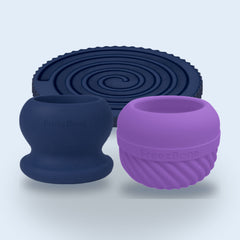
FreezBall, FreezSwirl and FreezJumbo: three shapes and three challenges in one set.
$66.85
Shop Best Seller Bundle - Our Most Popular Set -
Bone Refills 4-Pack
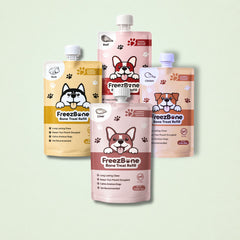
Ready-made fills in four flavors for the days you have no time to prep.
$14.95
Shop Bone Refills Dog Meat 90 Grams (4 Pack)®
Keep reading in Enrichment & Boredom

Enrichment for Senior Dogs: Gentle Brain Games and Soft Frozen Fills
An older dog's body slows down long before their brain stops wanting a job....

Is Bone Broth Safe for Dogs? Store-Bought vs Homemade, and How to Freeze It
Yes, bone broth is safe for most dogs, as long as it's plain: no...

Winter Indoor Boredom: What Changes When the Walks Get Short
Why dogs get restless when the clocks change, and a winter routine that replaces the lost walk time.