


Winter Indoor Boredom: What Changes When the Walks Get Short
Why dogs get restless when the clocks change, and a winter routine that replaces the lost walk time.

Something happens to dogs in November. The clocks fall back, the walks get shorter, and by early December a dog who was settled in September is chewing the baseboards, barking at nothing and pacing the kitchen at nine in the evening.
Owners usually read this as a behavior problem. It is almost always a math problem. Your dog's daily output has dropped by an hour, and nothing has replaced it.
Here is what actually changes in winter, and how to fix winter indoor boredom in dogs without standing in the rain.
Winter cuts walk length, off-leash time, yard time, social contact and novelty, but not your dog's energy. Replace the loss with mental work: breakfast from a frozen toy, a scent game, slower and sniffier walks, and a frozen fill in the restless evening window. Build fills from their own food so winter does not add weight.
What changes for dogs in winter?
Add up what a dog loses between October and January:
- Walk length. Dark mornings and dark evenings squeeze two decent walks into two short ones.
- Off-leash time. Fewer daylight hours in safe spaces mean more leash walking, which is far less tiring.
- Yard time. Cold and wet means most dogs go out, do their business and come straight back in.
- Social contact. Fewer dogs at the park, fewer people to greet.
- Novelty. The same short route, twice a day, in the dark.
That last one matters more than people expect. A dog's walk is mainly a sensory experience, not a cardio one. Sniffing an unfamiliar hedge does more for a dog's brain than another lap of the same block.
The result is a dog with the same energy and far fewer outlets. That energy goes somewhere, and the destinations are predictable: chewing, barking, pacing, following you room to room, waking early and getting into things.
Can mental work replace physical exercise?
Partly, and that is the useful thing about this problem: the fix is not more walking.
Problem-solving, sniffing, licking and chewing are genuinely tiring for a dog. A twenty-minute session working food out of a frozen toy produces a settled dog in a way that twenty minutes of leash walking in the rain does not.
Licking and chewing soothe
- They are calming behaviors, which is why dogs do them when stressed
- Frozen fills stretch the time spent doing them
Problem-solving tires
- Working food out of a shape takes concentration
- Concentration costs a dog energy
Sniffing settles
- Scent work is calming as well as occupying
- Anything that gets the nose working counts
Movement still matters
- Mental work does not replace exercise entirely
- Winter can be shorter on distance and longer on difficulty
What does a good winter routine look like?
A structure that works from November through February.
| When | What to do |
|---|---|
| Morning | Breakfast from a frozen toy instead of a bowl |
| Midday | Ten minutes of scatter feeding or a scent game |
| Afternoon | The walk, shorter but slower, with plenty of sniffing |
| Evening | A long-lasting frozen fill in the restless window |
| Weekend | One longer outing somewhere new |
Morning: breakfast in a toy
This is the single highest-return change in the whole routine. Their normal food, soaked and frozen the night before, takes 20 to 40 minutes instead of 90 seconds. It costs nothing, adds no calories, and your dog starts the day having done something. Prepare it the evening before so the morning is not a chore.
Midday: a scent game
Throw a handful of kibble across the lawn or a rug and let them find it. Free, and more tiring than it looks.
Afternoon: the slow walk
Let them sniff. A twenty-minute walk where your dog chooses the pace and stops constantly is more useful than a brisk forty-minute march. It is the biggest change most owners can make to a winter walk, and our post on why winter walks alone are not enough covers what to do once you are back inside.
Evening: the fill that stops the pacing
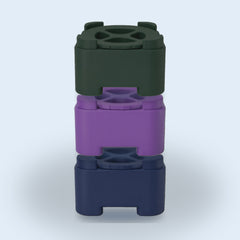
For most dogs, the restless hours fall between 7 and 9pm. Use a longer-lasting fill here: dense base, layered, packed tight. The format matters as much as the ingredients, and rotating between shapes keeps a clever dog engaged. The stackable FreezBrick is especially useful in winter, because you can layer a slow base under something more interesting.
Weekend: somewhere new
Novelty is what the weekday routine lacks. A different park in daylight on a Saturday resets a lot.
How do I keep winter enrichment going until spring?
Winter enrichment usually fails for a boring reason: people run out of prepared toys and stop bothering. Set up a batch system in November and it carries you to March.
- Pick one evening a week. Sunday works for most people.
- Fill six to eight toys in one go.
- Freeze them solid and stack them in the freezer door.
- Wash the used ones together in the dishwasher instead of one at a time.
“I LOVE that these stack and save space in the freezer!!!!”
Kara K., verified buyer
Two rules make it sustainable:
- Own at least three toys, so there is always a frozen one while the others are dirty.
- Build most of the volume from their own food, so the routine does not add weight over a winter of reduced exercise.
Will my dog gain weight over winter?
They can, and that second rule matters more in winter than in any other season. Exercise drops, enrichment goes up, and if the enrichment is peanut butter, the dog is heavier by February. Our fill calorie table shows the difference between a peanut butter fill and a broth-and-pumpkin fill, and it is substantial.
Low-calorie fills that last
- Unsalted bone broth
- 100% pumpkin purée
- Soaked kibble, packed tight
- Single-ingredient dried treats crumbled through a broth base
Go easy on
- Peanut butter as the main fill
- Chews you are not counting
- Rich extras on top of a full meal
Dry pieces outlast the liquid and stretch the session. More combinations are in the Freezbone recipe videos.
Which dogs struggle most in winter?
High-drive working breeds. Collies, spaniels, shepherds and pointers were bred to work all day, and they do not accept a shorter winter. These are the dogs who invent jobs when you do not give them one. Our Border Collie enrichment guide covers why rotating difficulty works better than simply doing more.
Adolescents between six and eighteen months. Winter coincides badly with the destructive phase. A dog who was fine in the fall can become genuinely difficult by January.
Short-coated and small dogs. They cannot stay out as long in the cold, so their deficit is bigger. Indoor enrichment is not optional for them, and toys sized for smaller portions make it easier.
Dogs who put on weight easily. Less exercise plus more food-based enrichment is a straightforward equation. Manage it by changing what goes in the toy, not by cutting the enrichment. Our English Bulldog enrichment guide covers this for a breed where it matters most.
Senior dogs. Cold aggravates stiff joints, and shorter walks are often necessary. Mental work becomes the main outlet, and low-effort options matter more than difficult ones.
What else helps besides food toys?
Worth having in rotation so the routine does not become one thing.
- Scatter feeding. Free, ten minutes, uses the nose.
- Cardboard boxes. Wrap a treat in paper inside a box. Messy, effective, costs nothing.
- Training sessions. Five minutes of teaching something new is genuinely tiring. Winter is a good time to teach a new trick.
- A snuffle mat or rolled towel with kibble tucked into the folds.
- Chews. Longer-lasting than most toys, though they add calories, so count them.
- A window seat. Some dogs will watch the street for an hour. Free entertainment.
Rotate. Three things used twice a week each beat one thing used every day.
When is it not winter boredom?
Worth ruling out before you blame the season.
- Pain. Stiffness and restlessness in older dogs can be arthritis worsening in the cold, not boredom.
- Separation anxiety. Distress specifically when you leave is a different problem, and enrichment alone will not fix it.
- Cognitive decline in seniors. Night pacing and disorientation in an older dog warrant a vet visit.
- Too little exercise overall. Mental work substitutes for some physical exercise, not all of it.
If new behavior appears suddenly instead of gradually, or an older dog changes noticeably, speak to your vet before assuming it is the season.
General information, not veterinary advice. If your dog's behavior changes suddenly, or an older dog becomes restless or disoriented, speak to your vet.
Frequently asked questions
-
Most dogs cope with a moderate reduction if mental work increases. What they do not cope with is a reduction in both.
-
Almost always a drop in daily output with nothing replacing it. Add structured mental work at the times of day your dog is most restless.
-
It is one of the best things you can do, particularly in winter. Use their normal ration so nothing extra is added.
-
Two is a good target: one in the morning and one in the restless evening window. More for high-drive breeds and adolescents.
-
No, provided you replace the lost stimulation. A slower, sniffier short walk plus indoor work often serves a dog better than a longer march in the dark.
-
Yes. Problem-solving, sniffing and licking are genuinely tiring. Twenty minutes of difficult food work settles most dogs more effectively than twenty minutes of leash walking.
Shop this guide
Buy 2 save 15% · 3 save 20% · 4 save 25%
-
FreezBrick
Stackable and modular: use it alone, add the challenge lid, or stack several in the freezer.
$26.95
Shop FreezBrick - Stackable Frozen Treat Toy for Dogs -
FreezBrick Tower Bundle
Soft lid: for soft food like yogurt or wet food. Best for gentle to...
$80.85
Shop FreezBrick Tower Bundle - Stack, lock, freeze, and save with the ultimate FreezBrick bundle

Keep reading in Enrichment & Boredom

Enrichment for Senior Dogs: Gentle Brain Games and Soft Frozen Fills
An older dog's body slows down long before their brain stops wanting a job....

Is Bone Broth Safe for Dogs? Store-Bought vs Homemade, and How to Freeze It
Yes, bone broth is safe for most dogs, as long as it's plain: no...

Your Dog Empties the Toy in Four Minutes. Here Is How to Fix It?
Nine fixes, ranked by impact, that turn a four-minute toy into a forty-minute one.