


Enrichment During Crate Rest: A Week-by-Week Plan
An eight-week plan for strict crate rest: the hardest weeks, low-calorie fills and games with no movement.

Your vet has said six to eight weeks of strict crate rest. No walks, no stairs, no jumping, no running. You have a dog who does not understand any of that, and roughly fifty days to get through without either of you losing your mind.
Crate rest fails for a predictable reason. Owners do it well for ten days, the dog starts feeling better, and by week three the dog is bored, frustrated and testing every boundary. That is when reinjury happens, not in week one. The way through is to replace physical output with mental work, deliberately and on a schedule. Here is a plan for the full eight weeks.
Keep a dog on crate rest busy with licking and chewing they can do lying down, plus stationary scent games and training. Frozen, low-calorie fills are the most useful single tool. Plan hardest for weeks two and three, take enrichment food out of daily meals to avoid weight gain, and follow your vet's rules above everything else.
What are the rules for enrichment on crate rest?
Follow your vet's instructions, not this article. Crate rest protocols differ by injury. Cruciate repair, spinal surgery, fractures and soft tissue injuries all have different rules about weight bearing and movement, so ask specifically what is allowed.
Ask three questions before you leave the clinic. The answers decide what is possible in the rest of this plan.
- Can my dog sit up and change position in the crate, or must they stay lying flat?
- Is any weight bearing permitted, and for how long?
- Can they lick and chew normally, or is there a mouth or neck restriction?
Enrichment must not create movement. A puzzle that makes a dog stand, pivot or paw is the wrong tool during strict rest. A licking and chewing activity done lying down is the right one.
Why is licking the best enrichment during crate rest?
Licking and chewing are self-soothing behaviors. They lower arousal, they can be done lying flat, and they pass the time without the dog having to move.
That combination is unusual. Most enrichment involves getting up, working at something and moving around it. A frozen fill held between the paws while lying down is one of the few genuinely useful options during strict confinement.
A 40-minute session that ends with your dog asleep is worth more during crate rest than three ten-minute activities that leave them alert and frustrated.
What should I do in week 1 of crate rest?
Your dog is sore, probably sedated and mostly asleep. This is the easy week, and it lulls people into thinking the whole thing will be fine.
- Keep everything quiet and dark. Let them sleep.
- One or two soft frozen fills a day, given lying down.
- Keep fills small. Appetite is often reduced after anesthesia and pain medication.
- Nothing rich. Stomachs are sensitive after an anesthetic.
- Feed meals by hand or from a shallow dish if reaching is difficult.
Freezbone tip
Use week one to build your freezer stock for weeks two to eight, because you will not have the energy later. Fill eight to ten toys and freeze them.
Watch for: a dog refusing food entirely. That is worth a call to your vet rather than a wait.
Why are weeks 2 and 3 of crate rest the hardest?
Expect whining, barking, attempts to get out, chewing the crate, and a dog who stares at you with real accusation. It is genuinely unpleasant, and it is normal.
Structure the day. Predictability reduces frustration more than variety does.
| Time | Activity |
|---|---|
| Morning | Breakfast from a frozen toy, not a bowl |
| Mid-morning | Quiet company. Sit by the crate, read, talk |
| Midday | Small frozen fill, or a scent activity |
| Afternoon | Sleep. Do not fill every hour |
| Late afternoon | The difficult window. Longest fill of the day |
| Evening | Second fill during family wind-down |
| Night | Nothing. Let them sleep |
Make the fills last. This is when technique matters. Freeze overnight, pack tight and layer it: liquid base, packed dense, dry pieces suspended in it, high value at the opening only. Our guide to fixing a toy that empties in minutes has the full method.
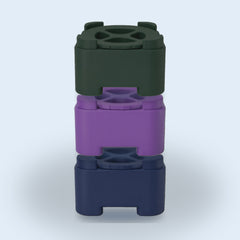
Rotate shapes. A dog with nothing else to think about solves a repeated shape quickly, so several formats matter more during crate rest than at any other time. The FreezBrick Tower Bundle gives you stackable sections you can vary week to week.
Calories are the trap. A confined dog burns far less than a walked dog, and you are now feeding several enrichment sessions a day. Weight gain during crate rest is very common, and it puts extra load on a healing joint.
The fix: take the enrichment food out of their meals rather than adding it, and build the bulk from low-calorie fills. Unsalted broth is roughly one calorie a tablespoon, against peanut butter's ninety-five. Our fill calorie table has the full comparison, and during crate rest the answer is always the broth end of the list.
How do I keep crate rest interesting in weeks 4 and 5?
The novelty of the routine has worn off for both of you. Your dog is coping better but still confined, so change the challenge, not the calories.
Add difficulty, not food
- Freeze in layers, letting each set before the next
- Use a narrower opening or an awkward shape
- Suspend dry pieces in a liquid base for two stages
- Introduce a shape they have not had yet
Scent work with no movement
- Hold three closed fists near the crate, a treat in one
- Let them nose at your hands
- It sounds trivial and is surprisingly tiring
Training with no movement
- Nose touch, chin rest, eye contact, "watch me"
- Learning the name of an object
- Five minutes, twice a day
- A chin rest also makes future vet visits easier
Move the crate
- Living room by day, bedroom at night if you can
- Being part of the household beats a bigger crate in a quiet room
What changes in weeks 6 to 8?
Your dog now looks fine. They are not cleared. This is the second reinjury window.
- Resist relaxing the rules early. Ask your vet before changing anything.
- Keep the routine identical. A dog who has adapted to a predictable eight weeks does not need it changed at week seven.
- Prepare for the transition. When exercise resumes, it will be short leash walks, built up gradually. Enrichment does not stop when crate rest ends; it tapers as physical activity increases.
- Mind the fitness gap. A dog who has not walked for eight weeks has lost muscle. The enrichment routine is what stops them trying to make up for it in one afternoon.
“Bought to keep my dog occupied during recovery after TPLO surgery. It worked absolutely fantastic. Loved this product so much I bought several more. Both dogs absolutely loved them and will beg at the freezer door!”
Terri H., verified buyer
What can I put in a toy for a dog on crate rest?
Priorities are different here: low calorie, long lasting, no movement required.
Best options
- Unsalted bone broth, frozen solid: around one calorie a tablespoon and lasts a long time. Check store-bought versions for onion and garlic
- Their own soaked kibble, packed dense: calorie-neutral against their ration
- 100% pumpkin purée: low calorie, sets firm, and the fiber can help with the constipation pain medication and inactivity often cause
- Water with dry pieces suspended in it: nearly calorie-free, with two stages of work
Avoid during recovery
- High-fat anything: a confined dog on pain medication does not need a pancreatitis risk on top
- Anything new: introduce nothing unfamiliar while they are on medication
- Rich fills that add calories to a dog burning almost nothing
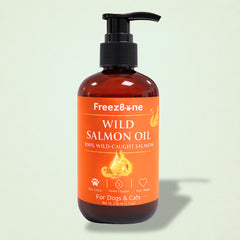
Worth adding: a few drops of Freezbone Wild Salmon Oil as a binder, which gets omega-3 into something your dog will definitely finish. Count it in the daily total, as it is calorie-dense, and check with your vet if your dog is on other medication. Crumbled cod treats or other single-ingredient treats, suspended in broth, outlast the liquid and extend the session.
Check with your vet before adding anything if your dog is on a prescription diet or several medications.
How do I use frozen toys safely during crate rest?
A few points matter more than usual.
- These are food enrichment toys, not unsupervised chews. Once the food is finished, some dogs start on the rubber, and a frustrated, confined dog is more likely than usual to do exactly that
- Take the toy out once the food is gone. Do not leave it in the crate as a comfort object
- Check for damage every session. A dog on crate rest cannot afford surgery for an obstruction on top of what they are already recovering from
- Nothing that makes your dog stand or pivot. No rolling puzzle balls, nothing that moves away
- Size sensibly. A large dog lying flat needs something they can hold between their paws
How do I look after myself during crate rest?
Rarely mentioned and genuinely important. Eight weeks of a frustrated dog is exhausting.
- Batch the prep. One session a week filling eight toys, not eight sessions of one.
- Accept that some days will be worse. A day where your dog whines for two hours is not a failure.
- Use the freezer as your buffer. Running out of prepared fills at 5 pm on a bad day is what breaks routines.
- Ask your vet about medication if your dog's frustration is genuinely unmanageable. Short-term anti-anxiety medication during confinement is a normal part of veterinary care, not a last resort.
Filling eight weeks? A wider spread of shapes keeps the puzzle fresh.
Combinations designed for long sessions are in the Freezbone recipe videos, and our post on winter indoor boredom applies the same idea of swapping physical output for mental work in a less extreme setting.
General information, not veterinary advice. Crate rest protocols vary by injury and procedure. Follow your vet's instructions, and contact them before changing anything about your dog's confinement or diet.
Frequently asked questions
-
Use licking and chewing activities that can be done lying down, plus scent games and stationary training. Frozen fills are the most useful single tool because they last long enough for your dog to fall asleep afterwards.
-
Low-calorie, long-lasting fills: unsalted bone broth, 100% pumpkin purée or their own soaked kibble, frozen solid.
-
Very easily, since they are burning far less. Take enrichment food out of their meals rather than adding it, and build fills from low-calorie bases like broth.
-
Commonly six to eight weeks, depending on the injury and procedure. Follow your vet's specific instructions.
-
Only as your vet permits. Many protocols allow short leash trips outside for bathroom breaks and nothing else.
-
Speak to your vet. Short-term anti-anxiety medication during confinement is a normal part of care, and a dog who is genuinely panicking is at risk of injuring themselves.
Shop this guide
Buy 2 save 15% · 3 save 20% · 4 save 25%
-
FreezBrick Tower Bundle
Soft lid: for soft food like yogurt or wet food. Best for gentle to...
$80.85
Shop FreezBrick Tower Bundle - Stack, lock, freeze, and save with the ultimate FreezBrick bundle -
FreezBone
Give your pet the natural boost they deserve with FreezBone Wild Salmon Oil. Made...
$18.99
Shop FreezBone - Wild Salmon Oil For Dogs & Cats
Keep reading in Enrichment & Boredom

Enrichment for Senior Dogs: Gentle Brain Games and Soft Frozen Fills
An older dog's body slows down long before their brain stops wanting a job....

Is Bone Broth Safe for Dogs? Store-Bought vs Homemade, and How to Freeze It
Yes, bone broth is safe for most dogs, as long as it's plain: no...

Winter Indoor Boredom: What Changes When the Walks Get Short
Why dogs get restless when the clocks change, and a winter routine that replaces the lost walk time.