


Best Calming Treats for Dogs in 2026: What Works and How to Choose
What calming treats can and cannot do, how long they take, daily-use safety, and where slow licking fits in.

If you live with an anxious dog, you know the signs by heart. Pacing, whining, chewing, scratching at the door the moment thunder rolls in. Calming treats for dogs promise to take the edge off, and pet parents keep asking the same question: do calming treats actually work, or are they just another trend?
The honest answer is sometimes, for some dogs, in some situations. Below: what the evidence says, how long calming treats take, whether they are safe every day, and the calming option we actually make, a frozen fill your dog licks slowly for a long time.
Calming treats can take the edge off situational stress like storms, fireworks, vet visits or travel for some dogs, but the evidence is mixed and results vary by dog, ingredient and dose. Choose products that list their active ingredients and amounts, follow the serving size, count the calories and talk to your vet before starting a supplement. They work best alongside training, exercise and enrichment, not as a standalone fix.
Do calming treats for dogs actually work?
It depends on the dog, the situation and the formula. Some dogs show calmer body language within an hour: less pacing, less barking, softer posture. Others do not respond at all.
There is some evidence that L-theanine, melatonin and certain herbal blends reduce situational fear, such as during storms, vet visits and fireworks, but results vary and often depend on consistent use. CBD has plenty of anecdotal support, but the research is mixed.
Dose matters as much as the ingredient list. A cheap product can name all the right ingredients and still contain too little of them to make a measurable difference.
Calming treats are not a magic fix. They work best as one part of a plan that also includes training, exercise and enrichment.
How common is anxiety in dogs?
More common than most owners expect, which is why so many people ask. A large Finnish study of about 13,700 pet dogs looked at fear and anxiety across the whole population, not just dogs brought to a behaviorist.
Noise sensitivity was the most common, affecting around 32% of dogs. Roughly 26 to 29% showed general fearfulness of strangers, unfamiliar dogs or new situations. Dogs with one anxiety trait often had others too, so a dog who hates fireworks may also struggle when left alone.
Two other findings are worth holding on to. Dogs with more socialization, better early care and more daily exercise tend to score lower on anxiety. And in kenneled and shelter dogs, enrichment has been linked to fewer stress behaviors, less vocalizing and better relaxation. That is a big part of why enrichment shows up later in this guide.
What are calming treats for dogs?
Calming treats are edible supplements made with ingredients meant to reduce stress and help a dog relax. They come as chews, soft bites or crunchy snacks, and they are usually aimed at separation anxiety, loud noises, travel stress and changes in a dog's surroundings. These are the active ingredients you will see most often:
| Ingredient | What it is | Worth knowing |
|---|---|---|
| L-theanine | Amino acid | May support relaxation without making your dog heavily sleepy |
| L-tryptophan | Amino acid | Used in some formulas to support normal serotonin production |
| Alpha-casozepine | Milk protein | Needs consistent use to build up, typically two to four weeks |
| Melatonin | Hormone | Mostly used for sleep and nighttime restlessness. Use only with your vet's guidance |
| Chamomile, valerian root | Herbs | Mild, with weaker evidence than their marketing suggests |
| Hemp or CBD | Plant extract | Popular, but research is still mixed and product quality varies. Talk to your vet first |
| Magnesium | Mineral | Sometimes added to support stress and sleep cycles |
How long do calming treats take to work?
It depends on what is inside. L-theanine tends to act within 30 to 60 minutes, so it is the ingredient people reach for before a known event. Alpha-casozepine works the other way: it needs two to four weeks of consistent use to build up. Some dogs show little change with either.
How long the effect lasts also varies by product and dose. Follow the label, and ask your vet what to expect for your dog rather than adding more if you do not see a change.
Are calming treats safe to give every day?
Many calming treats are made for regular use, but the dose matters. Follow the serving size, count them in your dog's daily calories and check with your vet before you start, particularly if your dog takes medication, has a health condition or has dietary restrictions. Melatonin, hemp and CBD products need your vet's input first.
How do I choose a calming treat for my dog?
Do not choose a product just because the packaging says "natural" or "calming." Turn it over and read the label.
- Check the active ingredients. Look for products that state clearly what they contain and how much your dog receives per serving. The evidence and intended use differ from one ingredient to the next.
- Check the serving size. More is not automatically better. Follow the manufacturer's instructions and consider your dog's size, age, diet and health.
- Check the calories. This one is easy to overlook. The American Animal Hospital Association recommends keeping treats and other non-complete foods to 10% or less of a dog's daily calories, and that includes calming chews.
- Match it to the trigger. A dog who panics during fireworks needs a different plan from a dog who gets bored when left alone. Think about the trigger first, then the product.
Not sure how much is too much? Our guide to how many treats to give your dog walks through daily allowances.
What helps in each stressful situation?
| Situation | What to consider |
|---|---|
| Thunderstorms | Calming routine, a safe space and enrichment |
| Fireworks | A quiet room, enrichment and veterinary advice if needed |
| Car travel | Travel training, enrichment and appropriate calming support |
| Being home alone | Gradual training, exercise and food-based enrichment |
| Evening restlessness | Exercise, mental stimulation and a predictable routine |
| Mild boredom | Interactive food toys and enrichment |
Notice how often enrichment appears. For big nights, our plan for keeping your dog calm during fireworks shows how to put it all together.
Calming treats vs enrichment toys: what is the difference?
A treat disappears in seconds. A food-based enrichment toy turns that same snack into an activity: you place food inside a fillable toy and let your dog lick, chew and work for it.
Freezbone takes this approach with fillable frozen dog toys and lick mats. You fill them with dog-safe food such as wet food, pumpkin, yogurt or treats, then freeze the filling so it lasts far longer than a handful of chews.
To be clear: a Freezbone does not treat anxiety or replace anxiety treatment. Its value is a structured, satisfying activity that gives a restless dog something to do.
| Feature | Calming treats | Frozen enrichment toy |
|---|---|---|
| Main purpose | Nutritional or supplement support | Mental stimulation and food enrichment |
| Needs active ingredients | Often | No |
| Works with regular dog food | Sometimes | Yes |
| Licking | Usually limited | Yes |
| Chewing | Depends on the product | Yes |
| Food lasts longer | Depends on the product | Can, depending on the filling and freezing |
| Useful for boredom | Sometimes | Yes |
| Suits every dog | No | Depends on the toy and the dog's chewing style |
| Replaces anxiety treatment | No | No |
The two can also work together. A calming supplement you have cleared with your vet and a good enrichment activity simply do different jobs.
Why does licking help calm a stressed dog?
Mental stimulation can settle a stressed dog in a way a quick treat cannot. Chewing, licking and problem-solving give nervous energy somewhere safe to go, and for many dogs that combination is calming in itself.
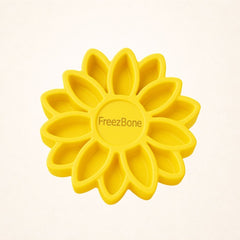
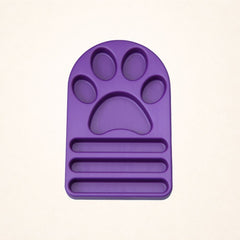
Fill a Freezbone with frozen pumpkin, broth, yogurt or Freezbone refills and you get up to 45 minutes of licking and chewing. Wide, shallow shapes like the FreezSunflower and lick mats like the FreezPaw Mat lean into the licking side. It satisfies the urge to chew, offers a cool, soothing texture and redirects restless energy into something positive.
“My dog loves the frozen sunflower dog chew. Use it after a long day outside - calms her and cools her off at the same time - thank you!”
Kimberly H., verified buyer
Want to understand the licking side better? Our guide to whether licking really calms a dog covers it in depth.
Which frozen fills work for anxious dogs?
Use dog-safe fillings that suit your dog's diet. Good bases include wet dog food, pumpkin, plain yogurt (if your dog tolerates dairy), mashed banana, dog-safe treats, kibble mixed with wet food, and a small amount of peanut butter that contains no xylitol. Six easy combinations to try:
- Pumpkin and yogurt: plain Greek yogurt mixed with pumpkin purée.
- Banana and peanut butter: mashed banana with natural, xylitol-free peanut butter for a slow lick.
- Blueberry and yogurt: plain yogurt blended with fresh blueberries.
- Pumpkin and kibble: your dog's regular kibble with pumpkin purée and a little water.
- Apple and yogurt: unsweetened applesauce stirred into plain yogurt.
- Chicken and broth: plain cooked chicken in low-sodium, dog-safe broth, for a savory option.
Freezbone tip
Timing is everything. Serve the frozen fill before the stressful event starts, or as it begins, so your dog is already busy when the storm, the guests or the car ride arrive.
Peanut butter is the one to double-check. Our xylitol guide shows what to look for on the label, and the Freezbone recipe videos show more fills step by step.


When should you consider calming treats?
Calming treats can be useful in a few situations:
- Short-term stress: fireworks, thunderstorms, vet visits or car rides.
- Mild separation anxiety: paired with enrichment, such as a frozen Freezbone, to head off destructive chewing.
- Routine relaxation: for dogs who need a little help winding down in the evening.
Pairing a calming treat with a frozen Freezbone session gives your dog two kinds of support at once: whatever the active ingredients offer, plus the steady work of licking and chewing.
“Our foster dogs in our rescue LOVE them! It helps so much with stress!”
Erin P., verified buyer
If your dog struggles most when you leave, our guide to toys for dog separation anxiety covers how to build that routine.
- Severe anxiety or behavior problems: work with your vet or a qualified trainer
- Before starting any new supplement
- If your dog takes medication or has a health condition
- Before using melatonin, hemp or CBD products
- If your dog has dietary restrictions


Short on time to make fills before a busy week? Ready-made refills take the prep out of it.
The short version
- Calming treats can reduce stress for some dogs, but the evidence is mixed and results vary.
- Read the label: clear active ingredients, a sensible dose and calories that fit the 10% rule.
- L-theanine acts within an hour or so; alpha-casozepine takes weeks. Herbal blends are milder than the marketing suggests.
- Talk to your vet before starting any supplement, especially for everyday use.
- A frozen fill gives an anxious dog a calming job through slow licking and chewing.
So, do calming treats really work? Sometimes. The real key is a balanced routine that meets your dog's physical and mental needs.
General information, not veterinary advice. Talk to your vet before starting any calming supplement, especially if your dog has severe anxiety, takes medication or has a health condition.
Frequently asked questions
-
Sometimes. Some dogs show calmer body language within an hour, while others do not respond at all. Results depend on the dog, the situation, the ingredient and the dose, and calming treats work best as one part of a plan that also includes training, exercise and enrichment.
-
It depends on the ingredient. L-theanine tends to act within 30 to 60 minutes, while alpha-casozepine usually needs two to four weeks of consistent use to build up. Some dogs show little change at all.
-
It varies by product and dose, so follow the label and ask your vet what to expect for your dog. If you want a calm activity you can predict, a frozen fill in a fillable toy keeps many dogs licking and chewing for up to 45 minutes.
-
Many are made for regular use, but the dose matters. Follow the serving size on the label, count the treats in your dog's daily calories (treats should stay at 10% or less), and check with your vet first, especially if your dog takes medication or has a health condition.
-
Choose products that clearly list their active ingredients and how much your dog gets per serving, and never give more than the label says. Talk to your vet before starting any supplement, and always before using melatonin, hemp or CBD products.
-
Yes. They do different jobs. A calming treat offers whatever its active ingredients provide, while a frozen fillable toy gives your dog a long licking and chewing activity. Many owners use both around a known stressful event.
Shop this guide
Buy 2 save 15% · 3 save 20% · 4 save 25%
-
FreezSunflower
FreezSunflower Meet the FreezSunflower, a beautifully designed enrichment toy inspired by the open shape...
$27.95
Shop FreezSunflower - Interactive Frozen Sunflower Dog Chew For Tough Chewers -
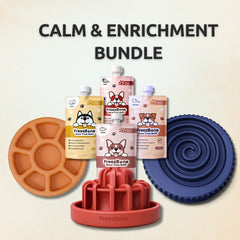
Calm & Enrichment Bundle
The Calm & Enrichment Bundle is thoughtfully designed to help dogs slow down, relax, and stay...
$79.85
Shop Calm & Enrichment Bundle - Calm Your Dog for Hours -
FreezPaw Mat
Paw-shaped lick mat with pads and grooves for spreading soft fills, then freezing.
$27.95
Shop FreezPaw Mat - Calming Slow Feeder
Keep reading in Anxiety & Calm

Holiday Houseguests: Keeping a Dog Settled When the House Is Full
A two-week plan for a calm dog in a full house: retreat room, guest rules, freezer prep and food dangers.

Toys for Separation Anxiety in Dogs: How Stimulating Toys Can Help?
Our five picks for dogs who struggle alone, when to give them, and what toys can and cannot fix.

How to Keep Your Dog Calm During 4th of July Fireworks
Why the usual fixes fall short, and a simple fill-walk-hand-over plan for fireworks night.