


Separation Anxiety Solutions: Can Licking Really Calm Your Dog?
Why licking settles anxious dogs, and how to use a frozen toy for departures, the crate and guests.

You pick up your keys and your dog starts pacing. By the time the door closes, the whining has started, and you spend the drive wondering what the neighbors are hearing. If that sounds familiar, you have probably asked whether something as simple as licking can really calm your dog.
It can help, a lot. Licking alone is not a cure for separation anxiety, but it is a powerful, reliable calming tool, and paired with the right routine it can genuinely change how your dog handles being alone. It is also one of the most underused strategies in the toolkit.
Yes. Licking is a natural self-soothing behavior, and a frozen, filled toy turns it into 20 to 45 minutes of focused calm. It works best as part of a routine: exercise first, a low-key exit, and the toy given before anxiety builds, not after a meltdown has started. Severe separation anxiety still needs your vet or a behaviorist.
What does separation anxiety actually look like?
Separation anxiety is a spectrum, and not every dog who barks when you leave has the clinical kind.
True separation anxiety
- A panic response, not drama or attention-seeking
- Destructive behavior, specifically when alone
- House-training breakdowns in a trained dog
- Drooling or panting near doors and windows
- Vocalizing that does not stop
Isolation distress
- Bored and under-exercised
- Has not learned that being alone is okay
- Far more common
- Responds well to enrichment and routine changes
Both are real problems, and they need different levels of help. Everything in this guide is useful for both, but if your dog is genuinely panicking, loop in your vet or a certified applied animal behaviorist as well.
Why does licking calm a dog down?
Rhythmic licking is self-soothing in the truest sense, a bit like a person's slow breathing or fidgeting when stressed. It is not just a trick or a distraction. Watch an anxious dog who is pacing and panting settle onto a frozen enrichment toy, and you will often see the body soften, the breathing steady and the eyes relax.
A frozen toy adds two things a room-temperature one cannot. The cold is soothing in its own right, and the frozen fill makes the licking last. A room-temperature stuffed toy is finished in minutes; a frozen one lasts 20 to 45 minutes with the right fill.
The goal is not to distract a panicking dog. It is to give a calm dog a reason to stay calm.
What is the best toy for a dog with separation anxiety?
Not every toy sold as calming lives up to the label. Here is what actually matters:
Look for
- A toy you can fill and freeze, so it lasts 20 to 45 minutes
- A lick-focused design: deep channels and textured surfaces that hold filling
- Natural rubber, especially for an anxious dog who may chew harder than usual
- The right size: big enough for a large dog, small enough for a small one
Avoid
- Room-temperature stuffed toys that are empty in minutes
- Cheap plastic or synthetic rubber that can crack
- A toy too small for a large breed: finished fast and a choking concern
- A toy too big for a small dog, which just puts them off
The FreezBone range covers several shapes and sizes, from the original FreezBones to the FreezCone and the FreezJumbo for power chewers, all made from natural rubber for freezing and filling. Freeze-capable, lick-focused and natural rubber: that is the checklist for an anxious dog.
“My puppy (9 wk) spent 25 minutes with her FreezBone. Normally she plays with something for 2 minutes before moving on. Great product! P.S. She slept like a rock afterwards too!”
Patrick L., verified buyer
What can calm my dog when I leave the house?
The honest answer is a combination of things, with a frozen lick toy as one of the most reliable single tools in that combination. Here is what a solid departure routine looks like in real life:
- Exercise before you leave. Even 15 to 20 minutes of sniff-focused walking takes the edge off. A dog with some exercise behind them settles faster when given a calming activity.
- Keep the goodbye low-key. No long emotional farewells and no nervous energy. Dogs read us like books. A calm, matter-of-fact exit tells them there is nothing to worry about.
- Hand over the frozen toy about 10 minutes before you go. Not at the door, where it turns into a goodbye signal. Your dog settles into licking, and you leave calmly while they are busy. Over time the routine becomes a reliable signal that everything is fine.
- Come home calmly too. Big, excited reunions feel great, but they spike arousal and make the contrast between alone time and together time very stark.
A FreezBone fits naturally into step three. Fill it the night before, freeze it overnight, and put it down about 10 minutes before you leave. Dogs are excellent pattern learners, and repeated consistently, this routine starts to take the edge off the anxiety spike at departure. If you are heading back to the office, our exit strategy guide goes through the timing in detail.
How do I keep my dog relaxed during crate training?
Crate anxiety and separation anxiety often overlap, and a crate introduced badly can make fear worse. The goal is a crate your dog chooses to be in, not one they are locked away in.
Frozen toys are one of the most effective tools for this because they work on several levels at once. Your dog has something to do, the licking is soothing, and all of that good experience happens inside the crate. The crate stops being the place where scary things happen and becomes the place where frozen peanut butter appears.
Freezbone tip
Start with the crate door open. Drop a filled, frozen toy inside and let your dog wander in and out freely. Do not close the door for the first week. Once they are going in on their own for the toy, close the door for short spells, still with the toy, and build up gradually. Patience is everything here.
Our crate training plan walks through the first two weeks day by day.
How do I help my dog settle when guests come over?
Doorbell chaos is one of the most common problems that sits right next to separation anxiety. The dog barks, jumps and cannot be calmed, guests feel awkward, and you feel embarrassed.
What works: give the frozen toy before guests come in, ideally on your dog's mat or in their safe space. It gives their mouth something to do (it is hard to bark and lick at the same time), their brain something to focus on, and their body a reason to settle.
It will not work the first time. It will work better the fifth time. With enough repetition, many dogs start heading to their mat when they hear the doorbell, because that is where the good stuff appears. Pair it with basic "place" or "settle" training and you have a real plan instead of crossing your fingers every time someone knocks.
How do I turn everyday snacks into a calming activity?
You do not need fancy ingredients, just the right vehicle for them. Anything your dog normally eats can become a calming lick session:
- Plain pumpkin puree (not pie filling) is low in calories and freezes firm. Mix it with a little plain yogurt for a two-ingredient fill most dogs love. Check the yogurt label for xylitol.
- Mashed banana and peanut butter is a classic. Use a peanut butter without xylitol.
- Soaked kibble, blended smooth and frozen, uses part of their daily food, which is ideal for dogs watching their weight.
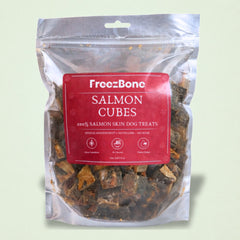
Freezbone treats make a great center reward. Bury a Salmon Skin Cube or a Chicken Chip in the middle of the fill so your dog finds a high-value surprise once they have worked through the outer layer. That buried treasure keeps the session engaging right to the end.
Freezbone tip
If your dog finishes too fast, go denser and colder. Fill the cavity completely with no air gaps, freeze for at least three to four hours (overnight is best), and use thick pastes rather than thin liquids. Peanut butter with mashed sweet potato, or cream cheese with pumpkin, freezes very firm. Layering helps too: freeze one layer, add the next, freeze again.
More fill ideas are in the Freezbone recipe videos.
When should I give the toy to reinforce calm behavior?
Timing is everything. You want the toy to appear during calm behavior, or as a reward for it, not as a distraction after a meltdown has already started.
If your dog is already barking and spiraling, a frozen toy will not switch that off. It works best ahead of time: give it while your dog is calm and you want to keep them that way. Over many repetitions, the toy becomes a cue for calm. Your dog sees the frozen toy come out and starts to settle before the first lick, because they have learned what comes next.
- If your dog cannot engage with food or toys when alone, even high-value frozen treats, the anxiety may be too high for enrichment alone.
- Severe separation anxiety may need behavior modification and, in some cases, medication prescribed by your vet.
- Enrichment supports the process. It does not replace professional help when anxiety is severe.
The short version
- Licking is a natural calming behavior, and a frozen fill makes it last.
- Give the toy before anxiety builds, not after.
- Departure routines matter as much as the toy: calm, consistent and predictable.
- The same tool works for alone time, the crate and guest arrivals.
- Everyday foods like pumpkin, yogurt and banana make good calming fills.
- Severe anxiety needs professional support. Enrichment is part of the solution, not all of it.
For more on which toys keep anxious dogs busy, read our guide to toys for separation anxiety.
Frequently asked questions
-
Licking is a natural self-soothing behavior, and trainers and owners consistently see dogs settle while they lick. Direct research on licking toys and stress hormones is limited, so treat it as a reliable calming tool rather than a cure.
-
Most frozen toys are worked through in 20 to 45 minutes, depending on your dog and the fill. Once it is empty, pick it up, rinse it the same day and repack it. Supervise the first few sessions with any new toy.
-
The fill may not be tempting enough, the toy may be unfamiliar, or your dog may be too stressed to eat, which is worth taking seriously. Start at room temperature with an easy fill, then move to frozen once your dog is keen. Some dogs need five to seven warm introductions first.
-
Yes. Daily enrichment is good care, not spoiling. Adjust meals for the calories in the fill, and lean on lower-calorie options like plain pumpkin, cucumber or diluted bone broth for everyday use.
-
Yes, with supervision and a toy that is the right size and cannot be easily broken down. The cold can help with teething discomfort. Use soft fills like plain yogurt or mashed banana for young dogs.
-
A calm dog has a soft body, easy breathing and is happy to engage when invited. A shut-down dog looks quiet but is stiff, blank and unresponsive, which can be a stress signal. Read the whole body, not just whether your dog is making noise.
Shop this guide
Buy 2 save 15% · 3 save 20% · 4 save 25%
-
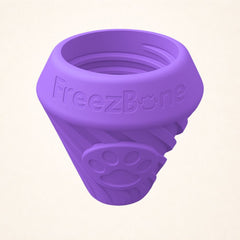
FreezCone
The FreezCone is what happens when enrichment meets smart design. Shaped like an ice...
$26.95
Shop FreezCone – The Ice-Cream–Shaped Enrichment Dogs Can’t Put Down -
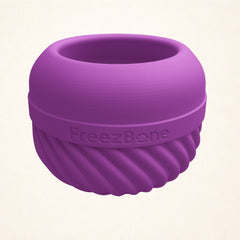
FreezJumbo™
The FreezJumbo was created for dog parents who are done wasting money on toys...
$16.95
Shop FreezJumbo™ – Our Biggest & Toughest Enrichment Toy Ever -
Salmon Skin Cubes
Salmon Cubes – 100% Salmon SkinCrunchy, protein-packed, and full of rich salmon flavor your...
$21.99
Shop Freezbone Salmon Skin Cubes Dog Treats- Single Ingredient (Value Size 8oz)
Keep reading in Anxiety & Calm

Enrichment for Senior Dogs: Gentle Brain Games and Soft Frozen Fills
An older dog's body slows down long before their brain stops wanting a job....

How to Calm an Anxious Cat? Vet Trips, Carriers, Visitors and Moving
Most anxious cats aren't anxious all day. They panic at predictable moments: the carrier...

Is Bone Broth Safe for Dogs? Store-Bought vs Homemade, and How to Freeze It
Yes, bone broth is safe for most dogs, as long as it's plain: no...