


Cat-Safe Frozen Fills: The List Is Not the Same as Dogs
Why the dog list does not cover cats, the fills that work, what to keep out and how much to give.

Most people assume a food that is safe for a dog is safe for a cat. It is a reasonable assumption, and it is wrong often enough to matter the moment you start filling a frozen toy for your cat.
Cats are obligate carnivores with a different metabolism, a much smaller body and a different set of vulnerabilities. Some things that barely trouble a dog are dangerous to a cat, and one thing that is seriously toxic to dogs reportedly does nothing to cats at all. If you are moving from filling a dog toy to filling one for a cat, this is what changes.
The safest frozen fill for a cat is a spoonful of their own wet food, frozen thin. Unsalted homemade broth, plain cooked fish or chicken and commercial cat pastes also work. Keep out onion and garlic (found in most store-bought broth), grapes, chocolate, xylitol, regular raw fish, raw egg white, bones and most dairy, and keep portions tiny.
How is a cat-safe fill different from a dog fill?
| Food | Dogs | Cats |
|---|---|---|
| Onion and garlic | Toxic | More toxic. Cats are considerably more sensitive |
| Dairy | Often tolerated in small amounts | Poorly tolerated by most adult cats |
| Raw fish | Not ideal | Thiamine risk if fed regularly |
| Macadamia nuts | Seriously toxic | Reportedly no effect |
| Liver | Fine in moderation | Vitamin A toxicity if fed often |
| Dog food | Their food | Nutritionally inadequate, lacks taurine |
| Xylitol | Serious emergency | Poorly documented, avoid regardless |
| Grapes and raisins | Kidney failure | Also documented in cats |
The allium point is the important one. Cats are markedly more sensitive to onion and garlic than dogs. Preventive Vet notes that red blood cell damage can occur from as little as 5 g of onion per kg of body weight, and that garlic is three to five times more toxic than onion. For a 4 kg (about 9 lb) cat, that is a very small amount.
Where this catches people out is liquid. Onion and garlic often arrive by accident in chicken broth, soup or baby food that owners add to encourage a cat to eat or drink more. Broth is the obvious fill for a cat who does not drink enough, and most store-bought broth contains allium.
Freezbone tip
Read every label, or make your own broth: plain chicken or fish simmered with nothing added. No onion, no garlic, no salt, no stock cube.
The macadamia surprise
This one runs the opposite way. Macadamia nuts, which are highly toxic to dogs, reportedly cause no problems in cats. That still does not make them a good filler: the high oil and fat in nuts can cause vomiting and diarrhea, and salted or chocolate-covered nuts should never be given.
Safety information does not transfer between species in either direction. Do not assume a dog list covers your cat.
What should I do if my cat eats something toxic?
Cats hide poisoning, and that changes how you should respond. A poisoned cat may not show symptoms for 12 to 24 hours, so act on the exposure rather than waiting for symptoms. Cats also mask illness in general, so a cat who seems fine after eating something they should not have is not proof that they are fine.
- Call straight away: ASPCA Animal Poison Control 888-426-4435, or the Pet Poison Helpline 855-764-7661. Both charge a fee.
- Do not induce vomiting unless instructed.
- Watch for lethargy, pale gums, dark or orange-red urine, rapid breathing, vomiting, loss of appetite and weakness.
What should never go in a cat's toy?
Never use
- Onion, garlic, chives, leeks, shallots and scallions, fresh, cooked, dried or powdered. That includes most store-bought broth, stock, gravy, soup and savory baby food.
- Chocolate and cocoa. Cats rarely seek it out, but they are smaller, so the toxic dose is reached faster.
- Grapes, raisins and currants. Acute kidney injury has been documented in cats.
- Alcohol, including anything that contains it.
- Caffeine: coffee, tea, energy drinks.
- Raw yeast dough. It rises in the stomach and produces ethanol.
- Xylitol and its aliases (birch sugar, wood sugar, E967). The evidence in cats is thin, which is a reason for caution rather than confidence.
- Raw fish as a regular item. Salmon, tuna and mackerel contain thiaminase, which destroys thiamine. Occasional small amounts are fine, but regular raw fish causes a serious neurological thiamine deficiency. Cooked fish does not carry this problem.
- Raw egg white. Avidin interferes with biotin absorption, and there is the salmonella risk.
- Bones. Cats choke on bones easily, and splinters can damage the digestive tract.
- Dog food. Not toxic, but nutritionally wrong. Cats need taurine that dog food does not reliably supply.
- Fat trimmings, which can cause pancreatitis in cats.
- Liver in quantity. Fine occasionally, but regular feeding risks vitamin A toxicity.
Our xylitol guide is written for dog owners but covers the overlapping ground. For cats, the list above takes precedence.
Can cats have yogurt or other dairy?
Nearly every dog-fill recipe starts with yogurt. For cats, that needs adjusting. Adult cats lack lactase, the enzyme needed to process dairy, so the feline version of lactose intolerance causes upset stomach, gas, cramping and diarrhea. The saucer of milk is one of the most persistent myths in pet care.
If you use dairy at all:
- Plain full-fat yogurt or kefir only: never flavored, never sugar-free.
- Very small amounts. A teaspoon, not a tablespoon.
- Test tolerance first with a quarter teaspoon and wait 24 hours.
- Stop entirely if there is any loose stool.
- Never cow's milk, and never for kittens, who need proper kitten formula.
Honestly, dairy is not worth the trouble for most cats. There are better options.
What can I put in my cat's frozen toy?
Build from things a cat is designed to eat.
Cat-safe fills
- Their own wet food. The best option by a wide margin. It is what they already eat, and it freezes into something they have to work at. Spoon a portion of their normal ration into the toy: calorie-neutral, no dietary conflict, no label to check.
- Unsalted homemade broth. Excellent for cats who do not drink enough, which is most of them.
- Plain cooked fish or chicken, flaked. Cooked, unseasoned and boneless. It freezes well and cats engage with it readily.
- Water with something suspended in it. A few flakes of their food frozen into plain water. Very low calorie, and it helps hydration.
- Commercial cat treats and pastes. Formulated for cats, so nothing to interrogate. Count them in the daily total.
- Plain pumpkin purée. Tolerated by most cats in small amounts, and useful for fiber. Check the can says pumpkin only.
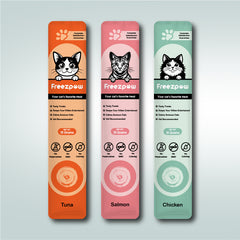
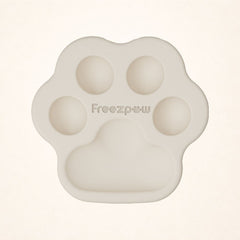
For formats sized to cats, the cat treat toys range covers what works. FreezPaw is designed specifically for feline portions and the lapping motion cats use. For a ready-made fill, Freezbone's Lickable Cat Paste Sticks come in tuna, salmon and chicken, in 15 g sticks.
“A good friend recommended that I get a Freezebone for my kitty and I’m beyond glad I did! Sophia LOVES her frozen treats and it will work out for a nice cool treat this summer!! Thank you Freezebone!!!”
Mary R., verified buyer
How much should I put in a cat's toy?
The volumes are much smaller than most owners expect.
- Split the existing ration rather than adding to it. Take a spoonful out of their meal and put it in the toy.
- Several tiny portions beat one larger one. Cats hunt several times a day and graze rather than commit.
- Use broth and water for volume. Nearly calorie-free, and it helps hydration.
- Freeze thin. A thick frozen block is too hard and too much. A thin layer sets faster and suits the way cats lap.
Our fill calorie table is dog-oriented, but the per-tablespoon values still apply; just scale down heavily. If your cat needs to lose weight, see slow feeding for overweight indoor cats.
How do I get my cat to use a frozen toy?
Cats give up faster than dogs, so the first attempt matters.
1. No barrier at all
- Smear something on the outside of the toy
- Let them investigate with no challenge
2. Fill it unfrozen
- Easy access
- Quick success
3. Freeze thinly
- A short freeze, not overnight
4. Build up
- Longer freezes and fuller portions
- Only once they engage reliably
If your cat walks away, it is too difficult. That is the single most common reason cat enrichment fails. Go back a step rather than waiting for them to work it out, because they will not.
Put it where they already eat, not somewhere new. In a multi-cat home, use separate rooms so a confident cat cannot monopolize it. Our guide to indoor cat boredom covers the multi-cat problem in more detail.
Which cats need extra care with frozen fills?
| Cat | What to do |
|---|---|
| Kittens | Very small amounts, once fully weaned. Kitten formula only, never cow's milk. |
| Cats with kidney disease | Common in older cats and often on prescription food. Check with your vet before adding anything, since protein and phosphorus matter. |
| Diabetic cats | Ask your vet before adding any carbohydrate. |
| Overweight cats | Split the existing ration. Never add extra calories to an enrichment program for an overweight cat. |
| Cats on prescription diets | A therapeutic diet works because it is the only thing they eat. Check first. |
| Seniors with dental disease | Softer fills, thinner freezes, and get the teeth checked. |
General information, not veterinary advice. Check with your vet before adding anything to the diet of a cat with a medical condition or on prescription food. If your cat has eaten something on this list, call a vet or poison control line straight away rather than waiting for symptoms.
Frequently asked questions
-
Yes, in small amounts and frozen thinly. Their own wet food is the best base.
-
Only if it contains no onion, garlic or excessive salt, and most store-bought broth does. Make your own, unsalted, with nothing added.
-
Small amounts of plain full-fat yogurt are tolerated by some cats, but most adult cats do not digest dairy well. Test with a quarter teaspoon first and stop at any loose stool.
-
Tuna as an ingredient in commercially produced cat food is fine. Raw fish fed regularly is not, because of thiaminase, and tuna in oil or brine is not a good fill.
-
It is almost certainly too hard. Cats abandon a challenge far faster than dogs, so make it easier: smear food on the outside, then fill it unfrozen, then freeze thinly.
-
Not directly. Reduce the portion heavily, drop the dairy, and check that nothing contains onion or garlic.
Shop this guide
Buy 2 save 15% · 3 save 20% · 4 save 25%
-
Lickable Cat Paste Sticks
Inside the Box: 12 or 24 Filler Sticks (15g each)Our Filler Packs come in...
$9.99
Shop Lickable Cat Paste Sticks -
FreezPaw Lick Pad
he Perfect Enrichment Toy for Feline Fun Introducing the FreezPaw, the ultimate playtime and...
$15.99
Shop Freezpaw Cat Relax Lick Pad -
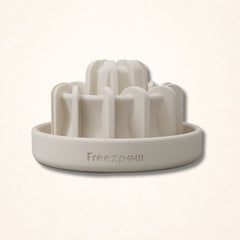
FreezDrip
A versatile cat toy with a unique lava-inspired design, the FreezDrip brings an extra...
$15.99
Shop FreezDrip Cat Flow Slow Feeder
Keep reading in Cats

Cat Lick Mats: What They Are, What to Put on Them and How to Freeze and Clean Them
What a lick mat does for a cat, the safe fills to spread on it, and how to freeze and clean it.

Cat Treat Toys and Treat Dispensers: Which Type Suits Your Cat?
Dispensers, lick toys and freezing toys compared, plus how to get a reluctant cat to try one.

Cat Paste Treats and Lick Sticks: How to Serve Them, How Many to Give and How to Make Them Last
Three ways to serve a lick stick, how many fit in your cat's day, and how to make one last longer.